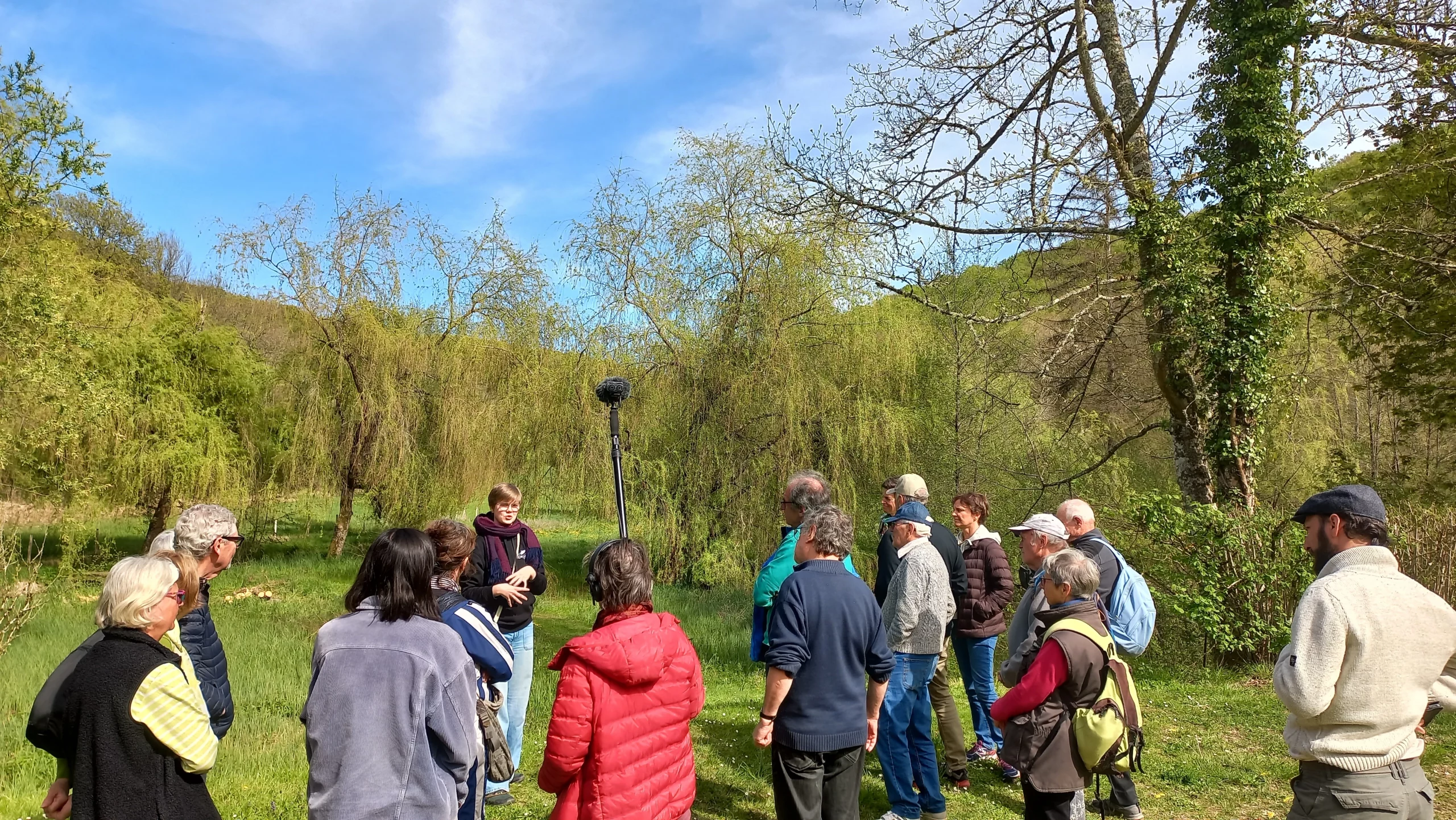
On the initiative of Astrid Willier, a student at the École Nationale Supérieure d’Architecture de Lyon, an exploratory walk focusing on water was organised on Wednesday 22 April 2026 in partnership with the Château de Lusigny–sur–Ouche. Situated near the source of the Ouche, which flows for nearly 100 km through the karstic soils and subsoils of the Côte d’Or, the Château de Lusigny is fully integrated into the history, geography and hydrology of the region.
Open to residents, neighbours and those living along the Ouche, or simply to the curious or those concerned about the preservation of water resources, this walk provided an opportunity to explore, through a hands-on approach, ways of living in the area, issues of local community life and conflicts of use, and to grasp the complexity of the physico-chemical interactions between so-called blue, green and grey waters. Christian Jacquemin and Elodie Denizart, administrators of Aqua, have been able to intervene and exchange with the participants at this occasion.
Walking and observing one’s surroundings along the water’s edge means understanding why humans came to settle in this valley, to carve it out, exploit it, but also to preserve it, visit it and rediscover it over the centuries. The uses of water have ranged from industrial activities such as quarrying and ironworking in the Epinac mines; to agricultural uses such as the retting of hemp or fish farming; to commercial ventures such as the construction of the Burgundy Canal, which follows the river from Pont d’Ouche to its confluence with the Saône at Saint-Jean de Losne, passing through Dijon…
It is clear that examining our relationship with water first raises the issue of practices and uses, each with its own set of positive and negative impacts on the environment.
By protecting drinking water catchments at source, do we prevent pollution caused by certain agricultural fields and the urbanisation of the plateau which, despite karst filtration, will end up at least partially in the resurgences?
How can we ensure a reliable flow to supply the Burgundy Canal, the drinking water network, irrigation of the alluvial plain, and also run-of-river hydroelectric power stations, when these hydrosystems are constantly interacting, whether visibly or invisibly?
Why build fish passes that are so costly, both economically and ecologically, when cormorants are plundering the fish stocks?
Are there any wetlands of natural origin, given that the valley has been exploited and developed for several centuries? And yet, do not ponds, water features, basins, pools or mill reservoir weirs provide the same services to the environment? And how can we preserve these humid microclimates, which are essential to life, in the face of the climate crisis?
What interactions exist between historic buildings and water, and what impact does the decline in water resources have on these structures? How can we renovate, restore and breathe new life into historic buildings such as castles, churches or mills today, despite or because of their structural longevity? And does the Energy Performance Certificate make sense for the renovation of old buildings?
What changes in scale and impact occur when technological choices are made, such as the widespread adoption of centralised sewerage systems?
Who bears responsibility for breaches in the foundations of a castle built on stilts, where the main mechanisms for managing the surrounding water level have been removed?
What are the strengths and limitations of the classifications established by regulatory texts: Natura 2000, ZNIEFF, Ecological Continuity, Historic Monuments, Listed or Designated Sites, National Park Reserves or UNESCO sites…?
All these questions were touched upon during this walk. They do not necessarily have answers, but one thing is certain: our relationship with water is a matter of land use planning and land occupation. And if local authorities wish to take the lead in ecological planning and climate adaptation, the issue of water must be integrated across all policies, starting with that of energy-efficient building renovation.
Examining the historical built environments of the towns and villages in the Ouche Valley can help us identify some of the solutions for resilience that are so sought after today, particularly in the face of the risks of drought and flooding. To achieve this, we need to foster conditions that encourage collective intelligence. Site visits are particularly inspiring in this regard.
Moving beyond issues of local interests and day–to–day conflicts to preserve water as a common good… a subject that combines expertise and civic engagement, seen as crucial interaction for Aqua association.